



The electrolyte for a supercapacitor directly affects its operating-voltage window, ionic conductivity, internal resistance, temperature behavior and achievable energy density. Aqueous electrolytes generally offer high ionic conductivity and can support strong power performance, but their practical electrochemical voltage window is relatively limited. Organic electrolytes can operate across a wider voltage window, which is important because the energy stored in a capacitor increases with the square of voltage, although organic systems generally involve lower conductivity and more demanding material and manufacturing considerations. For engineers and B2B buyers, however, electrolyte type should not be selected in isolation. Rated voltage, capacitance, ESR, leakage current, operating temperature, expected pulse current and lifetime must be considered together. When purchasing a finished supercapacitor, these measurable electrical specifications are usually more useful than asking only whether the internal electrolyte is aqueous or organic.
In an electric double-layer capacitor, the electrolyte provides mobile ions that move toward oppositely charged electrode surfaces during charging. The interaction between the electrolyte and the porous electrode structure is therefore central to charge storage and ion transport. Electrolyte properties such as ion size, conductivity, viscosity, solvent stability and compatibility with electrode materials influence the final electrical behavior of the device. This is why two supercapacitors with similar capacitance can perform differently under a high-current pulse.
The electrolyte can influence:
Maximum practical cell voltage
Ionic resistance
ESR and power capability
Energy density
Low- and high-temperature behavior
Leakage and self-discharge behavior
Long-term stability
Compatibility with electrodes and separator materials
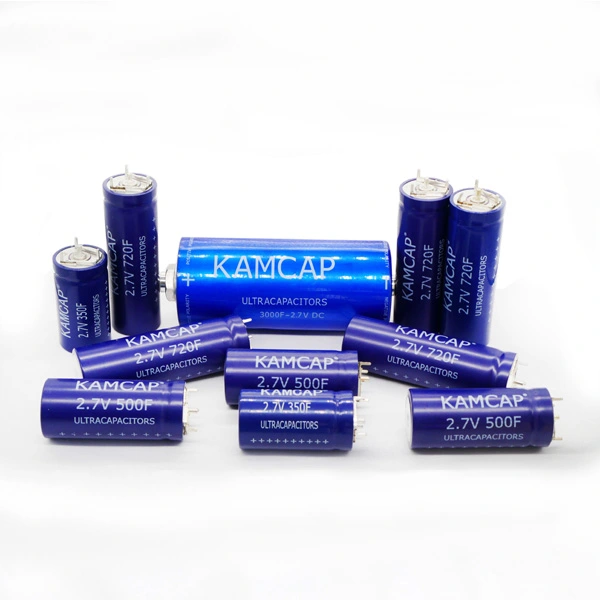
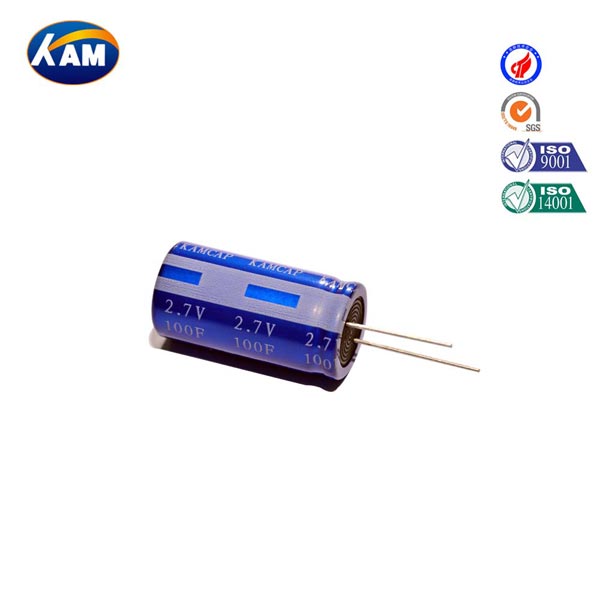
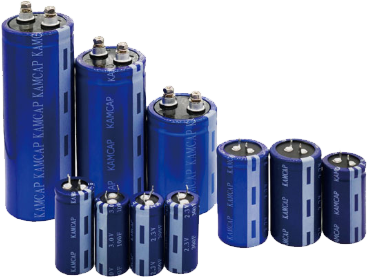
Kamcap's current 2.7V Winding Type Supercapacitor range covers approximately 0.1F to 3000F and includes configurations intended for both energy and high-power applications. Its published specifications provide rated voltage, capacitance, temperature range and life data—the kinds of parameters engineers should use when evaluating a finished component. Importantly, buyers should not infer an exact electrolyte formulation merely from a product's rated voltage unless the manufacturer discloses it. Electrolyte composition is only one part of a commercial cell design.
Aqueous electrolytes use water as the solvent and can be acidic, alkaline or neutral depending on the electrochemical system. Their major technical advantage is relatively high ionic conductivity, which can reduce ionic resistance and support rapid charge movement. Their main limitation is the narrower electrochemical stability window associated with water.
Organic electrolytes use non-aqueous organic solvents with dissolved salts. They generally provide a wider electrochemical stability window than conventional aqueous systems, allowing higher operating voltage per cell. This is valuable because capacitor energy follows:
E = ½CV²
Increasing the usable voltage can therefore have a strong effect on stored energy even when capacitance remains unchanged. The trade-off is that organic electrolytes generally have lower ionic conductivity than aqueous electrolytes, while solvent viscosity and ion transport can increase resistance. Electrolyte research therefore involves balancing voltage window, conductivity, safety, temperature range and electrode compatibility rather than maximizing one property.
| Property | Aqueous Electrolyte | Organic Electrolyte |
|---|---|---|
| Solvent base | Water | Organic solvent |
| Ionic conductivity | Generally higher | Generally lower |
| Practical voltage window | Lower | Higher |
| Power potential | Strong due to ion transport | Depends strongly on formulation and ESR |
| Energy-density potential | Limited by voltage window | Higher voltage can increase stored energy |
| Temperature behavior | Depends on solution and concentration | Depends on solvent and salt formulation |
| Engineering priority | Conductivity and power | Voltage window and energy |
| Main design challenge | Water decomposition / voltage limitation | Resistance, solvent properties and material compatibility |
These are general electrochemical tendencies, not guaranteed specifications for every commercial device. Final component data should always come from the actual manufacturer's datasheet.
For high-current applications, electrolyte conductivity matters because ionic resistance contributes to the total resistance encountered during charge and discharge. ESR is particularly important because a high discharge current causes an immediate voltage drop approximately related to:
Voltage drop = Current × ESR
It also generates resistive heating. This means a supercapacitor can have adequate stored energy but still be unsuitable for motor starting, actuator backup or pulse power if its ESR is too high. Kamcap's low esr supercapacitor range is specifically designed around reduced internal resistance for applications requiring rapid energy release. Kamcap publishes AC ESR values for individual LR-series models rather than relying only on generic claims such as “high power.”
Voltage influences the other side of the equation. Because stored energy scales with voltage squared, widening the usable voltage range can substantially increase energy capability. This is one reason organic electrolytes have become important in commercial EDLC development.
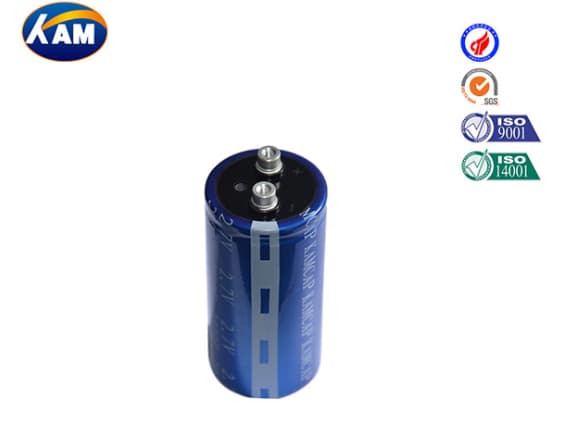
However, neither electrolyte type is automatically “better.” A lower-voltage device with very low ESR may be preferable for an intense short pulse, while a higher-voltage device may better serve an application where energy per unit volume is more important. For high-current industrial designs, Kamcap also offers a Full Welding Supercapacitor Series covering 2.7V–3.0V and high-capacitance configurations. Its published positioning emphasizes low internal resistance and high-current applications.
For most OEM projects, selecting a commercial capacitor by electrolyte name alone is not sufficient. Start with the electrical duty. Determine the maximum charging voltage, minimum acceptable load voltage, peak current, discharge duration and repetition rate. Then calculate the required usable energy and evaluate whether the component's ESR will create excessive voltage drop or heat.
Temperature also needs to be checked against the specific series rather than against a generic statement about electrolyte chemistry. For example, Kamcap's published 2.7V winding series includes different temperature specifications depending on product family, while its 3V winding products also publish their own rated operating ranges.
A practical RFQ should include:
Maximum and nominal operating voltage
Required capacitance or backup time
Peak and continuous current
Maximum permitted voltage drop
Charge/discharge frequency
Ambient operating-temperature range
Required component dimensions
Lifetime or cycle expectations
PCB, terminal or module configuration
Application and destination market
For designs requiring a higher cell voltage, engineers can evaluate Kamcap's 3v supercapacitor, which is currently offered from 1F to 500F. Selection should still be based on the published capacitance, ESR, temperature and life specification rather than assuming that “3V” alone defines performance. This distinction is useful for procurement: the electrolyte explains why certain performance trade-offs exist, while the datasheet tells you whether the finished capacitor actually meets your system requirements.
Supercapacitors can use aqueous, organic, ionic-liquid and other emerging electrolyte systems. Conventional commercial EDLC discussions commonly distinguish between aqueous and organic electrolytes, while current research also covers ionic liquids, gels and hybrid formulations.
Its relatively high ionic conductivity can be advantageous for power performance, but actual power capability depends on the entire cell, including electrodes, separator, terminals and ESR. Aqueous electrolyte alone does not guarantee a low-ESR finished capacitor.
A major reason is their wider electrochemical voltage window. Since stored capacitor energy is proportional to voltage squared, higher usable voltage can improve energy-storage capability.
This should not be assumed from voltage alone. Rated voltage is a specification of the finished component. Buyers requiring details of electrolyte chemistry should request confirmation from the manufacturer rather than infer formulation from the product name.
It contributes to ionic resistance, but total ESR also depends on electrode structure, separator, current collectors, terminals and overall cell construction. The finished-product ESR specification is therefore more useful for application design.
Provide operating voltage, capacitance or energy requirement, peak current, allowable voltage drop, discharge duration, duty cycle, temperature range, available dimensions and expected lifetime. These parameters allow the appropriate cell or module family to be evaluated.
Kamcap specializes in the development, production, and sales of supercapacitors. If you are interested, please contact us by phone +86-18640666860 or email info@kamcap.com.
Springer Nature — A Review on Electrolytes for Supercapacitor Device — review of aqueous, organic, ionic-liquid and other electrolyte systems.
ACS Energy & Fuels — A Comprehensive Review of Novel Emerging Electrolytes for Supercapacitors — comparison of aqueous, organic and ionic-liquid electrolytes.
Frontiers in Energy Research — A Review for Aqueous Electrochemical Supercapacitors — technical review of aqueous-electrolyte supercapacitor systems.



 English