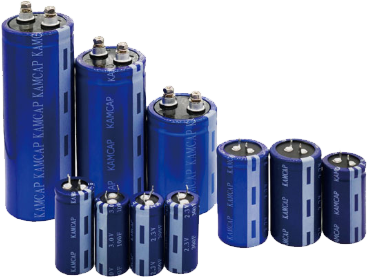




Choose a 12V, 24V or 48V supercapacitor module according to the system’s actual DC bus voltage, allowable operating range, peak-current demand and required usable energy—not simply by choosing the highest voltage. A 12V-class module is often appropriate for compact automotive and low-voltage backup systems, a 24V supercapacitor fits many industrial controls and intermediate-voltage power systems, while 48V-class modules are better suited to higher-power DC buses where reducing current for the same power level can simplify cables and power electronics. The module voltage must also leave enough margin below its maximum allowable voltage. Capacitance, ESR, cell balancing, minimum usable voltage and temperature should be reviewed together before a final module is selected.
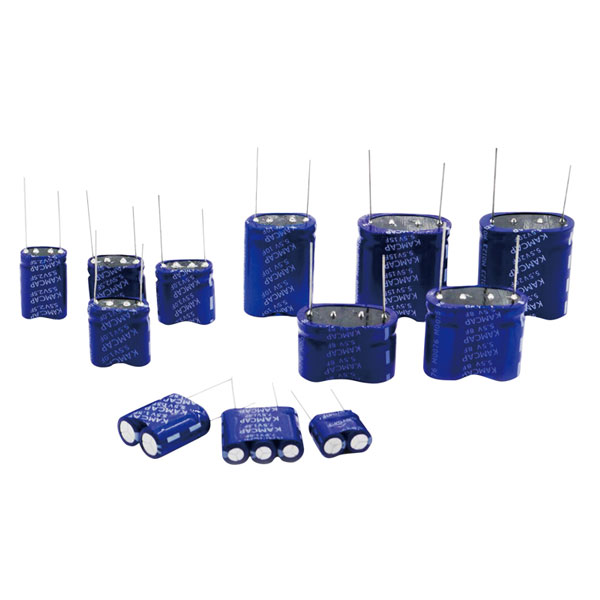
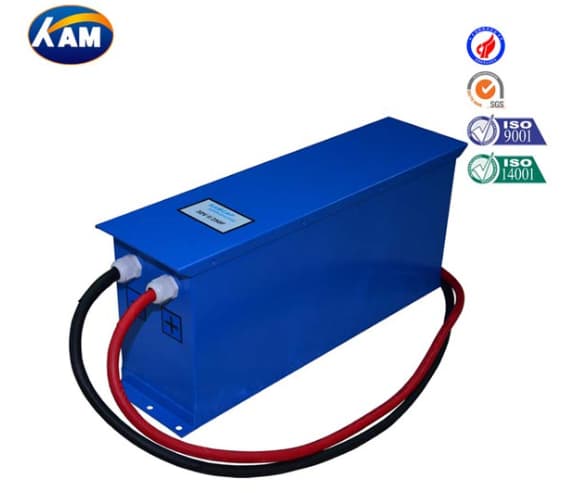
A supercapacitor cell operates at only a few volts, so a higher-voltage supercapacitor module is created by connecting multiple cells in series. Kamcap’s MK Module Series uses series and parallel configurations to increase both system voltage and capacitance, with available module classes extending from 3.3V to 120V. The current product table includes 12V-, 24V- and 48V-class options among other voltage ranges.
First, more cells are generally required in series. In an ideal series string, the total voltage capability increases while equivalent capacitance decreases compared with an individual cell. This is why engineers should never compare 12V and 48V modules by voltage alone.
Second, voltage affects the current required to deliver a given amount of power. For a simplified DC load:
Power = Voltage × Current
A 2.4 kW load would theoretically draw 200 A at 12V, 100 A at 24V and 50 A at 48V before efficiency losses and voltage variation are considered. Higher-voltage systems can therefore reduce current requirements, but they also require insulation, switching devices, protection and controls designed for that higher voltage.
Third, the complete module requires reliable voltage balancing across the individual cells. Kamcap states that its module products incorporate protection circuitry and use series/parallel assembly to increase operating voltage and capacity.
The current IEC 62391-1:2022 standard covers fixed electric double-layer capacitors used mainly in DC circuits and establishes common terminology, inspection procedures and test methods. It provides a useful technical framework when comparing supercapacitor specifications from different suppliers.
One of the most important misunderstandings in supercapacitor selection is treating capacitance in farads as if it were the complete energy specification. Stored capacitor energy depends on both capacitance and voltage:
E = ½CV²
This means voltage has a squared relationship with stored energy. However, a real application normally cannot discharge the module all the way to zero volts. The more useful calculation is therefore based on the operating window:
Usable energy = ½C(Vmax² − Vmin²)
This is why engineers need four numbers before comparing modules:
Maximum charging voltage
Minimum usable system voltage
Module capacitance
Required discharge duration
The energy relationship for supercapacitors is well established in capacitor theory, and supercapacitor systems typically experience declining terminal voltage as they discharge. ESR is equally important for applications requiring high current. Internal resistance causes an immediate voltage drop when current is drawn and also produces heat. A module may therefore have sufficient theoretical energy but still fail to support the load if ESR is too high.
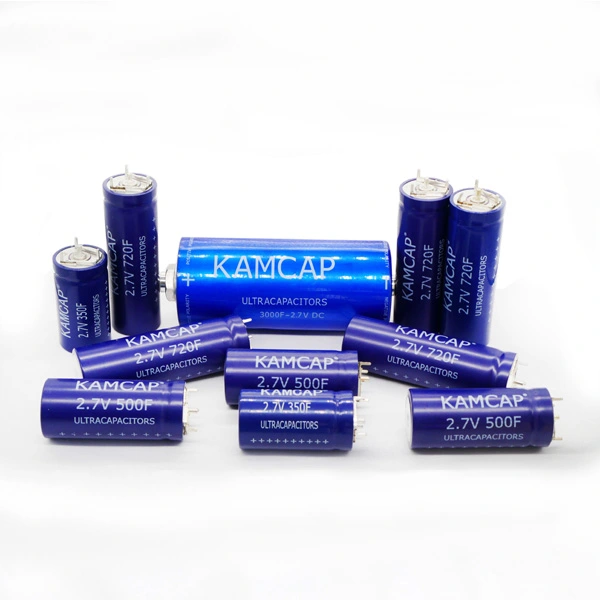
For applications requiring rapid current delivery, engineers can also evaluate Kamcap’s Low ESR 2.7V Winding Supercapacitors or Full Welding Supercapacitor Series when developing customized module architectures. Kamcap positions these cell families for applications requiring low resistance and high-current discharge. The U.S. Department of Energy also notes that supercapacitors differ from batteries in their ability to charge and discharge rapidly, which is one reason they are frequently considered for short-duration, high-power applications.
A 12V supercapacitor module is a practical starting point when the surrounding electronics already operate around a 12V bus. Typical examples can include vehicle electronics, engine-start assistance, compact backup systems and low-voltage controllers. Kamcap’s MK module page identifies vehicle starting, industrial backup, distribution terminals, fault indicators and medical equipment among its module applications.
A 24V supercapacitor becomes attractive when the equipment is built around a 24V-class industrial bus. Industrial controllers, automation systems, power-distribution terminals and backup circuits often benefit from avoiding unnecessary DC-DC conversion between the storage module and the load. The main design task is to verify the actual maximum charging voltage—not merely the nominal “24V” system label.
A 48V supercapacitor module fits higher-power DC systems where current becomes difficult to manage at lower voltage. Examples can include industrial drives, larger backup systems, AGVs and higher-power DC links. At the same power level, raising the bus voltage reduces current, which may lower conduction losses in cables and switching components.
However, 48V should not be chosen simply because it appears more powerful. Higher voltage generally means:
More series-connected cells
More balancing channels
Higher-voltage switching devices
Different insulation and connector requirements
Additional protection considerations
Potentially lower equivalent capacitance for the same cell configuration
The correct voltage is therefore the one that integrates naturally with the host equipment.
| Selection Factor | 12V Class | 24V Class | 48V Class |
|---|---|---|---|
| Typical system type | Low-voltage vehicle and electronics | Industrial control and mid-voltage DC systems | Higher-power DC systems |
| Current for same power | Highest | Medium | Lowest |
| Series cell count | Lower | Medium | Higher |
| Balancing complexity | Lower | Medium | Higher |
| Cable/current demand | Higher at high power | Moderate | Lower at equal power |
| Main buying priority | Compact integration | Voltage match + usable energy | Power delivery + bus integration |
| Good starting applications | Start assist, compact backup | Automation, industrial backup, terminals | AGV, high-power backup, DC links |
For B2B procurement, do not send an RFQ that says only “need a 24V supercapacitor.”
Provide:
Nominal DC bus voltage
Maximum charge voltage
Minimum load operating voltage
Peak and continuous current
Required backup or pulse duration
Repetition frequency or duty cycle
Ambient and maximum operating temperature
Available installation dimensions
Communication or monitoring requirements
Expected cycle life and annual quantity
These parameters allow capacitance and ESR to be sized around the actual duty rather than selected from a voltage label alone. Kamcap’s 2.7V Winding Type Supercapacitor range extends from small-capacitance products to high-capacity cells and includes high-power variants for instantaneous-current applications, providing another option when engineers need to develop a customized series-connected module.
Not automatically. A 24V module is better when the equipment operates around a compatible 24V bus. A 12V module may be more suitable for a 12V electrical system because it avoids unnecessary voltage conversion.
Series connection can increase total voltage, but this should only be done when the modules, balancing system, protection circuitry and manufacturer instructions permit it. Do not assume two independent modules can always be connected safely without engineering review.
Only if capacitance and the usable voltage window are appropriately comparable. Stored energy follows ½CV², but series connection normally changes equivalent capacitance, so voltage alone cannot determine total usable energy.
There is no universal farad value. Calculate the required capacitance from maximum and minimum operating voltage, load power or current, required duration and allowable voltage drop. Then verify ESR and thermal performance.
ESR contributes to instantaneous voltage drop and resistive heating during high-current discharge. Low-ESR designs are especially important for motor starting, pulse power and other applications with large peak currents. Kamcap offers dedicated low-ESR and full-welding cell series for such requirements.
Provide nominal and maximum voltage, minimum operating voltage, peak current, continuous current, operating time, charge source, temperature range, available space, duty cycle and application. These parameters make it possible to select voltage, capacitance and cell configuration together.
Kamcap specializes in the development, production, and sales of supercapacitors. If you are interested, please contact us by phone +86-18640666860 or email info@kamcap.com.
IEC — IEC 62391-1:2022, Fixed Electric Double-Layer Capacitors: Generic Specification
U.S. Department of Energy, ARPA-E — Graphene-Based Supercapacitors


 English